

After 2 years post-Covid, organizations and employees are still in a state of change adapting to the new environment.
As a new entreprenuer, I’ve enjoyed the recent gift of reflection and time to learn. I’ve read a lot. I’ve learned new skills, some I never imagined (website creation, newsletter publishing, Hubspot skills, etc.)
I also decided to reflect on my past blogs (as part of my Organizational Design Portfolio from Graduate School). It’s a long one, but provides questions to consider during times of change.
As they say, the more things change, the more they stay the same.
My post: Navigating change with empathy….& yoga pants from 2020, is a good example of this. I thought I’d reflect on the last 2 years, and see how we as leaders can consider the changes our employees and customers have experienced, and the unpredictable environment we still live in.
How might we help our employees, children, partners, mentees, customers and friends during these crazy times?
Here’s my 2022 refresh:
We are still realizing our global VUCA world (volatile, uncertain, complex and ambiguous) that COVID-19 has launched us into – ready or not! And now with the added complexity of war, recession, inflation, healthcare access, COVID variants, etc. how do we remain sane? Let alone, create a sense of community for our teams.
In 2020, many companies were faced with the incremental changes that needed to be made to sustain business (remote working), and now, we all need to assess the transformational change that will be necessary to survive after COVID-19 and beyond.
We see companies now asking people to return to office (the dreaded RTO), but for many of us, we found independence, eventual balance and success working remotely. Sure, we missed human connection, but some of that was due to COVID isolation that is no longer required.
Many knowledge working and tech teams (in highly productive industries), were successful, so how might we learn from remote work, make changes to our process and technology to enable effective hybrid virtual teams?
We can (and should) look at the macro level of organizational change (process, structure, people, rewards, capabilities), to enable more large sustained change we saw that can afford employees success in this new hybrid world.
Basic needs are still important
Maslow’s hierarchy of needs shows us that at it’s foundation, people need to feel safe and have basic physiological and biological needs met. While this is most often taken for granted, at this time, we know that this foundational needs are at risk. Let’s face it, our world will not return to the time before COVID. We’ve learned and experienced too much.
In 2022, some employees realized a new found freedom and ease in work from home. But some employees and customers may still be feeling unsettled in one or more of these areas (sleep, employment security, health, access to healthcare, etc.). If and when these are impacted, it is for them to show up as their best selves as parents, as employees or as leaders every day. As leaders and practitioners we can keep this top of mind and ensure we are supporting wellness as much as possible. We must shift our mindset to consider what their “new normal” may be.
The Remote Manager Report, by HeyKona.com, researched over 150 technology companies in 2020, and they reported that over 60% of managers struggled with lack of connection or team morale. And nearly 70% of employees faced burnout or mental health concerns. These are critical basic needs to be addressed. Have we made a dent in this since 2020? What else can we do to help teams feel safe, well and fulfilled?

Source: https://www.thoughtco.com/maslows-hierarchy-of-needs-4582571
We had our eyes on a transition to the post-COVID-19 normal (what is the new normal, have we arrived there yet?), but now, we have other disruptors to our way of being and working.
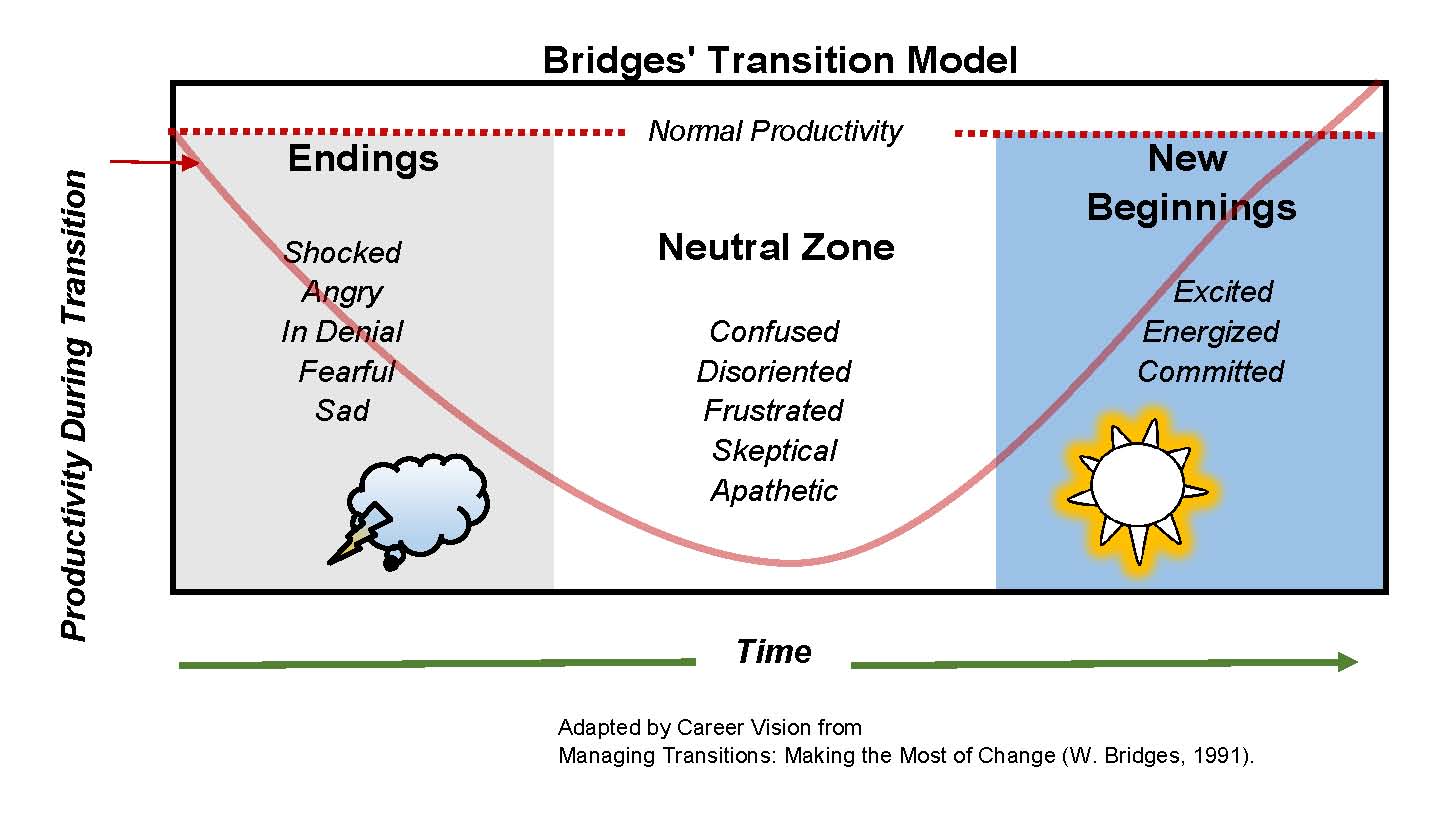
Employers, employees and customers will most likely continue to experience Bridge’s three phases of transition:
- Ending, Losing, Letting go of what was
- The Neutral Zone
- The New Beginning
As organizations, can leaders also adapt to a change in a new era of working?
These phases may overlap, and each individual will move through phases differently than others. That neutral zone may be long and drawn out, with a few more unexpected swerves. As we map out our teams, we may see team behavior that is impacted by individuals at different phases. Ongoing changes in our environments may send people and companies from new beginning back to transition.
Bridge’s can help remind us that we all don’t have the answer quite yet, and we most likely will (if we have not yet) seen a decrease in productivity. As leaders, we can recognize these emotions and anxiety in our employees and ourselves.
Lead with empathy, presence and courage (& possibly more asynchronous work, please)
From an empathic design point of view, I like to look at our opportunities through our users’ lenses. Our users are our front-line employees delivering on the daily work and our customers and clients receiving our product or services.
How has COVID-19 changed what they all THINK, DO or NEED? How can we be present to listen to their needs and concerns, and to let them know, it’s okay not to be okay. And help define what our the new expectations right now.
How has COVID enlightened or disrupted the way we work? Do we need to return to the previous normal? How might work look? How can we replace face to face work with transparency to work (rather than increased meetings and increased emails – perhaps we envision more asynchronous work (>60% of tech companies made this shift in the 1st year of Covid)
- Visibility to Ongoing Work
- Project boards replacing team emails & update meetings
- Microsoft Teams Planners
- Trello
- Monday
- Notion
- Visible communication threads
- Microsoft Teams (channels per project or customer)
- Slack (dedicated channels)
- Project boards replacing team emails & update meetings
- Rethinking Work Process
- Enable new technology (data analytics to find trends, gaps, etc.)
- Don’t just overlap technology onto existing process –> ask, what question we are trying to answer, adjust process as needed
- Explicit vs. Tacit Knowledge Managment
- Ensure instutional knowledge is curated (no longer can we (or should we) rely on hallway Q & A
Still do check-ins with your team
While we may not be co-located with our teams , as leaders we can conduct weekly 1:1 check-ins with employees and key stakeholders. These can take less than 15 minutes. Start by being vulnerable. Show humility. This will be messy, and it’s okay to acknowledge this. Embrace the discomfort. Be courageous. Ask questions to learn about each individual situation. Build trust.
Above all, let us all anchor ourselves on our organizational purpose and values. Most likely, these have not changed during COVID, but perhaps we have an opportunity to amplify our values. During the Great Resignation, lived organizational values are critical to retaining and attracting great talent.
Our end users (employees, stakeholders & customers)
What do our employees and stakeholders think right now? What are they doing in their day (beyond the 8 hours of focused work, are they teaching children, providing for others, or working on the front lines concerned for their health or job)? How is the recession impacting their family financially? What do our employees need right now (personally and professionally)? Do they need expectations to be revisited? Do they need flexibility on the core working hours? Do they need physical equipment (computer screens, desks, printers, etc.) to be most effective? Lots of questions.
As practitioners, we tend to consider change within our organizations, but now we must consider how our customers are impacted by COVID-19? How might our products or services need to adapt to meet their new needs? How have they adapted in life during/after COVID, and how might we need to acccomodate their needs?
What are our customers thinking? What are they doing or what might they being doing differently? If our “product” is a clinical trial, how might our clinical sites need to conduct trials differently and how might this change the frequency of patient visits? Data collection? How might this impact our patient’s willingness to participate in a clinical trial if there is a risk of safety going to a hospital setting?
During this time, interviews to understand the think, do, need and feel can be helpful to understand the needs of our employees, stakeholders and customers. As we see patterns emerge, it may offer us an opportunity to address incremental change that may ease fear or concern and allow for small wins to get us back to a new normal, whatever that may be. And as we see individual needs, it may offer us an opportunity to be human and kind to allow others to work through the three stages of transition with grace.
The COVID era brought me to the realization of taking a chance to become an entrepreneur – to pursue my love of helping people and small companies become the best they can.
I continue to be amazed at how resilient people are through these changes. They continue to do important work. I am also amazed and energized by people thinking about what could be possible for their futures and finding more fulfilling paths. And, that can include, working while wearing joggers, shorts and yoga pants.
Sources:
- Bridges, W.B. (2016). Managing transitions: making the most of change. Da Capo Press: Boston, MA
- Hopper, E. (2020). Maslow’s hierarchy of needs explained. https://www.thoughtco.com/maslows-hierarchy-of-needs-4582571
- The Remote Manager Report (2021). https://www.heykona.com/manager-report